A settembre 29, 2026, EVE Energy published details of its Open Source Battery 4.0: AI Battery debut at IAA Transportation 2026. The company said the platform includes LMX chemistry cells such as LM815, LM285, and V63, as well as commercial-vehicle battery systems for heavy-duty trucks and buses. EVE also described the AI Battery as integrating a custom AI chip to support cell-level active sensing, real-time diagnostics, and intelligent optimization.
Per acquirenti e team di ingegneri, the important signal is not only that another commercial-vehicle battery platform has appeared. The more practical change is that pack design is becoming more data-intensive. A commercial EV battery pack must still meet voltage, capacità, mechanical envelope, raffreddamento, protezione, and communication requirements, but intelligent sensing adds another layer: how the battery detects abnormal cell behavior, how diagnostic data is transferred, and how the BMS responds before a small imbalance becomes a reliability issue.
This matters for vehicle applications because commercial vehicles operate across long duty cycles, temperature swings, payload variation, and charging-condition differences. A battery system designed for one route profile may not behave the same way in another. Cell-level sensing can improve visibility, but it does not remove the need for pack validation. Mechanical mounting, percorsi termali, high-voltage insulation, accesso al servizio, and software communication must still be checked at the project level.
Per gli acquirenti di moduli e PACK, the lesson is clear: intelligent cells or battery platforms should be evaluated as part of a complete integration chain. A pack using advanced cells still needs compatible BMS logic, connector design, percorso del cablaggio, enclosure protection, progettazione termica, and end-of-line test planning. The buyer should ask what data the cells provide, how the BMS uses that data, whether diagnostics are accessible to the vehicle controller, and what fault-handling behavior is expected under vibration, low temperature, fast charging, or high-load operation.
Vista LYTH:
EVE’s launch reflects a broader shift from passive battery packs toward monitored battery subsystems. Per LYTH, the useful angle is engineering adaptation: advanced cells and intelligent platforms may create stronger buyer demand for project-specific module design, Corrispondenza BMS, revisione termica, and manufacturable PACK layouts.
Cosa può fare LYTH:
LYTH can support cell sourcing review, sviluppo del modulo batteria, integrazione PACK personalizzata, Adattamento del BMS, and application matching for commercial EV and industrial electrification projects, subject to cell availability, project specifications, e requisiti di convalida.
Fonti: EVE Energy announcement


 Localizzazione europea delle batterie LFP e pianificazione dei moduli
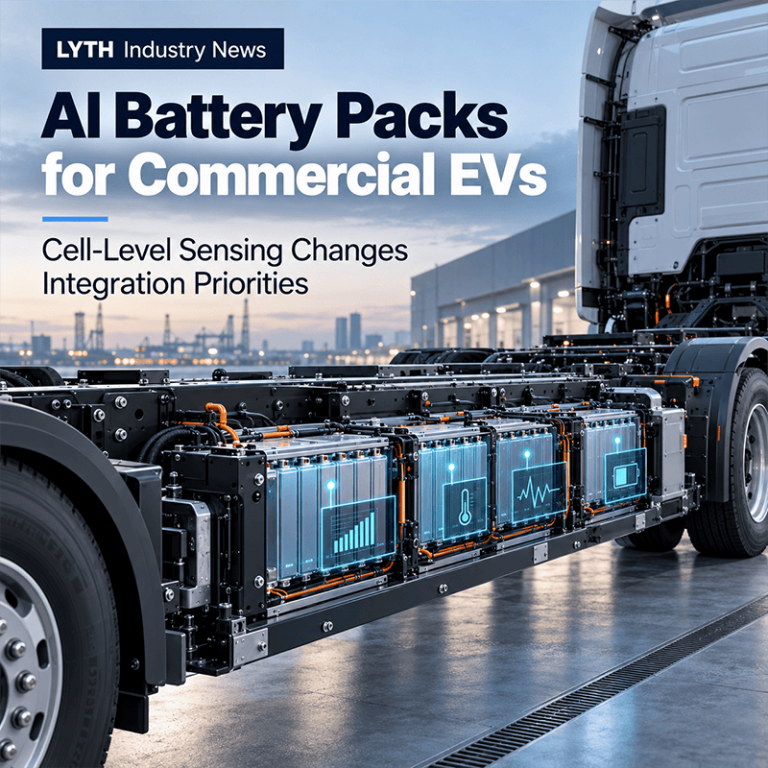 Pacchi batterie AI per veicoli elettrici commerciali: Cosa cambia il rilevamento a livello cellulare per l'integrazione
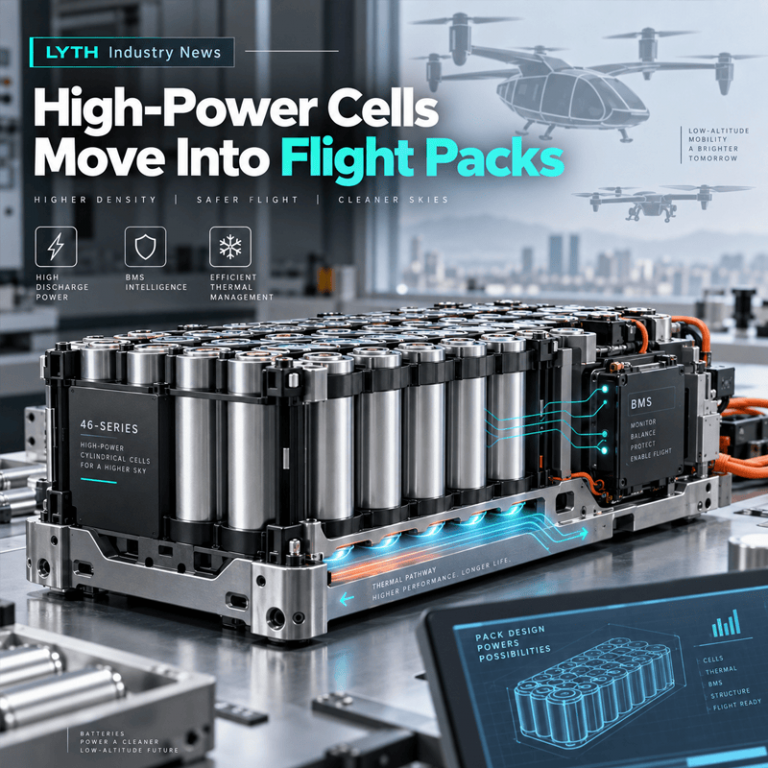 Le celle ad alta potenza si spostano nei pacchi di volo: Cosa richiedono le batterie a bassa quota oltre la capacità
 588Le celle LFP Ah e 601 Ah passano dalla roadmap del prodotto al segnale di produzione
 Produzione localizzata di pacchi batteria: Cosa segnala agli acquirenti l'accordo CATL-BME