На 12 Октябрь 2026, CATL announced that it had participated in the Global Battery Alliance (GBA) Battery Passport pilot programme for a third consecutive wave. CATL said this made it the only battery company with passports published across all GBA pilot waves. The GBA describes its 2026 operational trials as work by 17 supply-chain partnerships on data collection, third-party assurance, digital-platform integration and value-chain collaboration. The GBA also cautions that the trials use developmental methodologies and should not be used to rank participating companies or products.
Прямой ответ: What records should remain traceable when cells are assembled into an export-oriented battery module or custom PACK? A useful traceability chain keeps the cell model and production batch connected to its supplier documentation, incoming inspection, конфигурация модуля, electrical and mechanical build records, BMS version, test results, and any approved change. A QR code or serial number alone is not enough if it cannot connect those records consistently across the module or PACK lifecycle.
The immediate commercial importance is not that every buyer must now demand a specific passport label from every supplier. Rather, the GBA’s operational work shows the direction of travel: customers, regulators and downstream partners increasingly need reliable evidence of what was built, from which inputs, under which configuration, and how a change was controlled. For a battery module or custom PACK, that evidence needs to survive the point where individual cells are assembled into a larger subsystem.
This is an engineering issue as much as a sustainability issue. A cell data sheet may identify chemistry, вместимость, voltage limits and basic handling requirements. Once cells are integrated, the finished battery also acquires module drawings, busbar and insulation choices, compression or restraint arrangements, thermal interfaces, Параметры БМС, firmware identification, enclosure details and end-of-line test data. If one of those items changes, a buyer needs a controlled way to know whether the original validation still applies.
The most useful buyer discipline is therefore configuration control. Before approving a module or PACK, request a clear product identifier and bill of materials; identify the cell model and batch-recording method; agree what tests are tied to that configuration; and define how substitutions, BMS revisions or mechanical changes will be communicated. This is especially important where availability changes require a proposed alternative cell. Similar nominal capacity does not make two cells equivalent, and a replacement may affect dimensions, терминалы, voltage curve, thermal behaviour, charging limits or documentation.
Traceability also matters after delivery. A serialised build record can support incoming inspection, техническое обслуживание, field-failure analysis, warranty discussion and future design revisions. тем не мение, the record needs appropriate governance. Buyers should clarify who owns the data, what fields are shared, how commercially sensitive information is protected, how long records are retained and whether the format can be used by downstream customers. A credible system is practical enough for production teams to maintain, not just a presentation prepared for a tender.
For LYTH’s relevant markets, the key message is modest but actionable: traceability should be designed into the module and PACK workflow before a project reaches batch production. The current GBA trials do not establish that a particular LYTH product has a GBA passport, nor do they prove a specific certification result. They do show why buyers should ask earlier for evidence pathways that connect cell sourcing, module assembly and custom-PACK testing.
ЛИТ Вью
The battery-passport signal is best understood as a change-control requirement. For modules and custom PACKs, the value lies in keeping the actual build configuration connected to source, inspection and validation records when a cell batch or design detail changes.
Что может сделать ЛИТ
LYTH can evaluate cell-model matching, support module and custom-PACK configuration definition, coordinate BMS and thermal/safety requirements, and help define the records required for samples and batch manufacturing. Any project-specific passport, certification or data-sharing requirement remains subject to the applicable market, customer specification and validation scope.
Источники


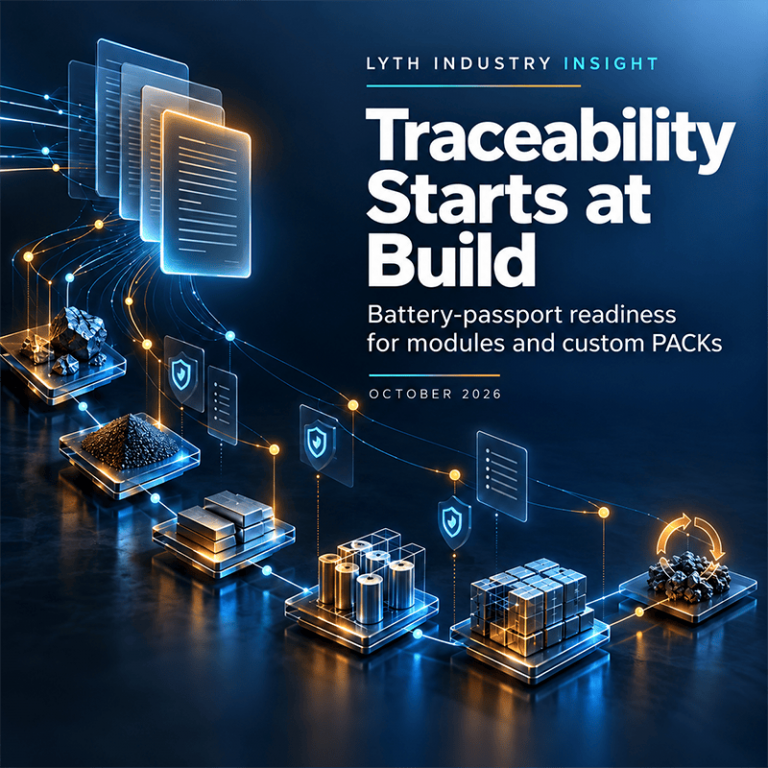 Готовность паспорта батареи для модулей и пользовательских ПАКЕТОВ
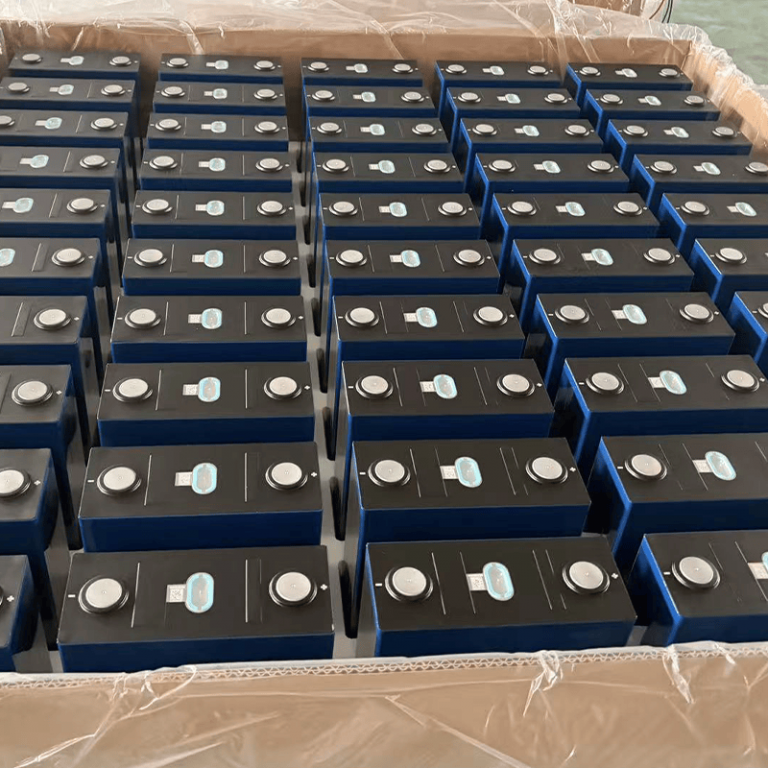 ЛИТ Корабли 16,000 Аккумуляторные элементы CALB 314 Ач в Европу
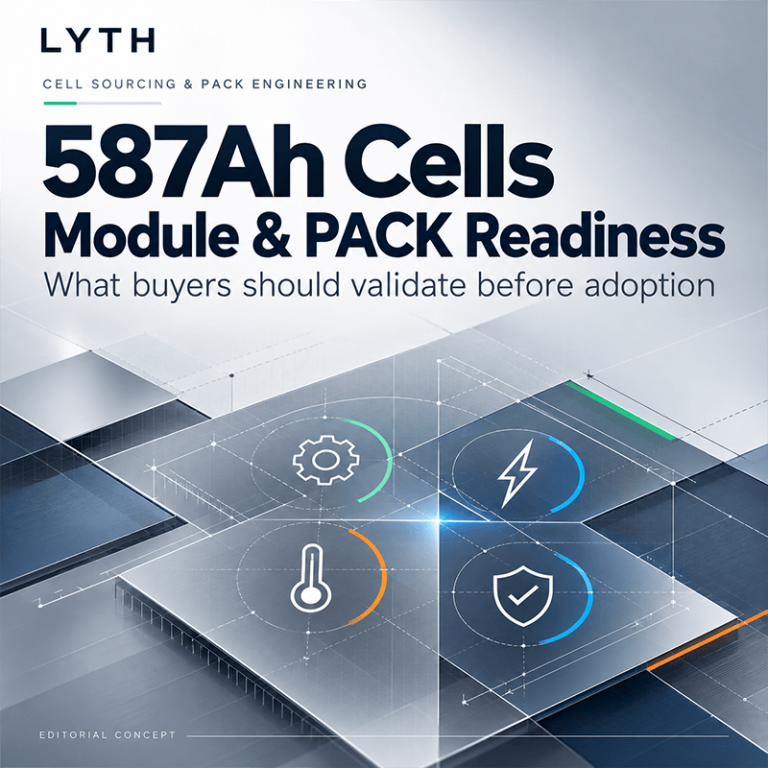 587Средства массового производства элементов Ah для покупателей аккумуляторных модулей и блоков
 Интеграция двухкластерного хранилища: Сокращение затрат на оборудование или реальная электрическая архитектура?
 314Элементы Ah LFP по-прежнему важны для планирования аккумуляторных модулей