On September 8, 2026, OFweek reported that Inpow Battery’s “Dafang Wuyu” 587Ah large-format energy-storage cell had entered mass production, following a September 5 rollout. The report frames the product as part of a wider 500Ah+ ESS cell trend, where higher single-cell capacity is intended to reduce cell count, simplify system architecture, and improve Wh-level economics.
Risposta diretta: A 587Ah cell does not automatically create a ready module or PACK. Before adoption, buyers should confirm the cell’s dimensional tolerance, expansion behavior, compression window, thermal interface, current path, BMS measurement range, handling method, certification path, and batch consistency. Large capacity improves integration potential only when the module architecture and production process are validated together.
The industry change is important because large-format cells concentrate more energy into each cell. That can reduce the number of cells and interconnects, but it also raises the consequence of a single-cell fault, increases fixture demands, and changes the way heat, swelling force, and service access must be managed. A module designed around 100Ah, 230ah, or 280Ah cells cannot simply be enlarged on paper and treated as production-ready.
Per LYTH, the article should be positioned as an engineering interpretation, not a claim that LYTH already supplies this exact 587Ah model. The useful buyer question is: What must be checked before a 500Ah+ cell can be used in a custom ESS module or PACK?
The practical answer starts with mechanical design. Larger cells require controlled compression, stable insulation spacing, reliable busbar geometry, and a fixture that can tolerate cell expansion through the expected operating life. Thermal design is equally important. A larger cell may reduce part count, but the cooling plate, pad material, contact pressure, and temperature-sensor placement must still keep cell temperature spread within the project’s safe design window.
Electrical and BMS adaptation must also be treated as a new design step. The BMS needs suitable voltage, attuale, temperatura, balancing, protezione, and communication settings for the selected cell and application. For light commercial storage, backup delle telecomunicazioni, and small ESS battery cabinets, this is often more important than headline cell capacity because the duty cycle may involve long standby time, partial cycling, high ambient temperature, or restricted enclosure airflow.
Vista LYTH: The 587Ah trend is a signal that ESS cell competition is shifting from specification announcements to production consistency and integration readiness. For LYTH’s business scope, the strongest angle is not full-container ESS deployment, but the module/PACK engineering checklist that buyers should apply before choosing a large-format cell.
Cosa può fare LYTH: LYTH can support battery module and custom PACK projects by reviewing cell format, application load, disposizione meccanica, BMS requirements, thermal coordination, and manufacturing feasibility. Per le nuove celle di grande formato, LYTH should treat adoption as engineering evaluation subject to specification review, sample validation, and project-specific production checks.
Fonti: OFweek 587Ah Inpow report, Inpow news center, CATL quality speech context


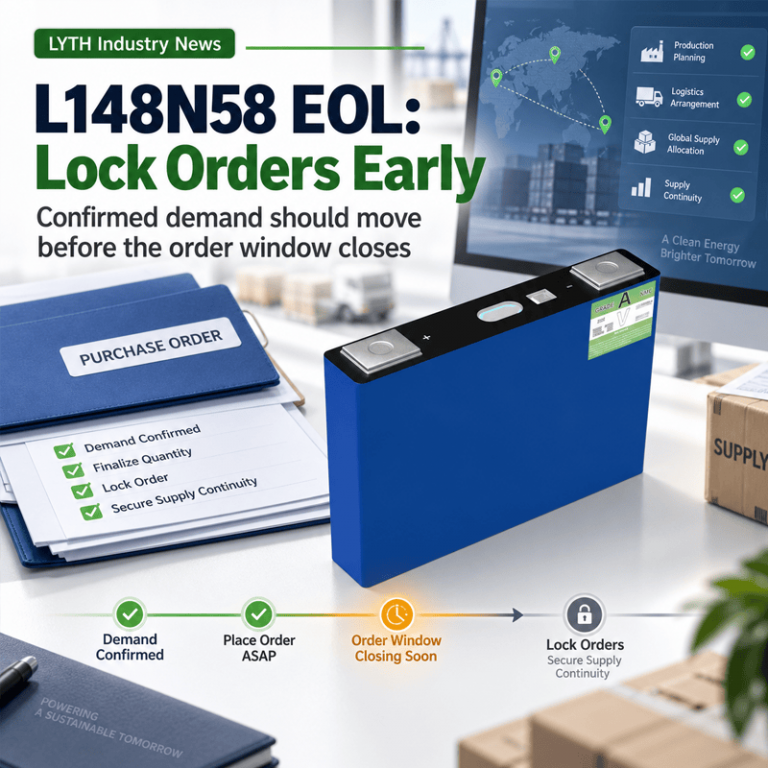 L'avviso EOL cella CALB L148N58 da 58 Ah segnala una finestra di pianificazione dell'approvvigionamento per gli acquirenti di batterie
 La preparazione del Battery Passport inizia con migliori dati a monte della batteria
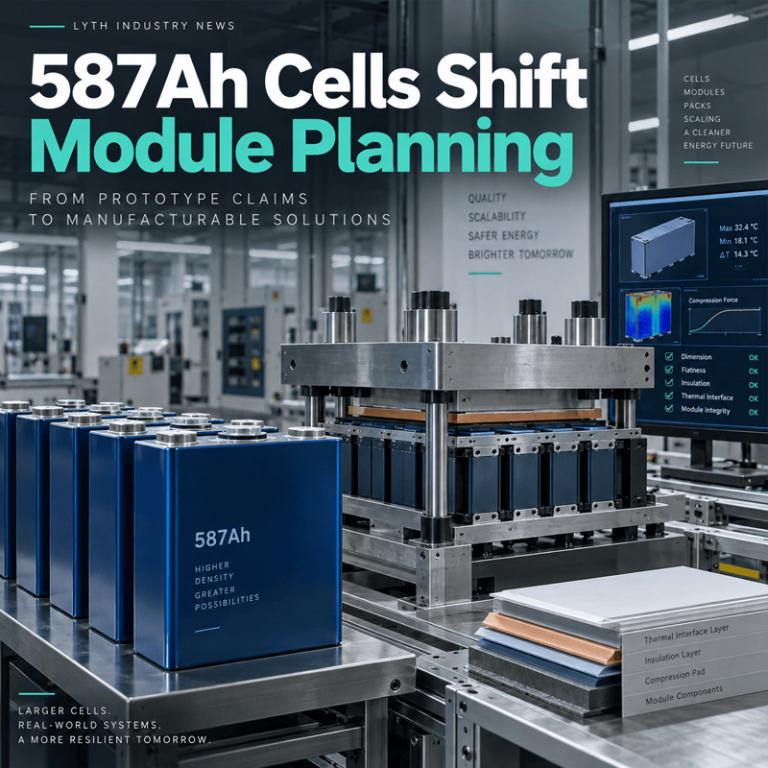 587Le celle Ah spostano la questione dalla capacità alla disponibilità del modulo
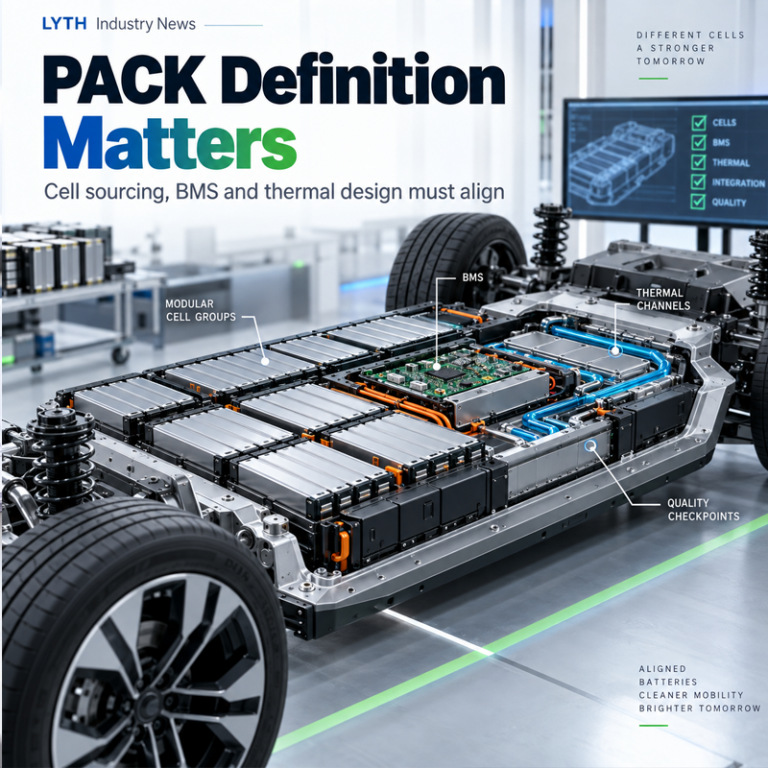 La definizione di PACK è importante poiché le case automobilistiche separano l'alimentazione delle celle dal controllo del sistema batteria
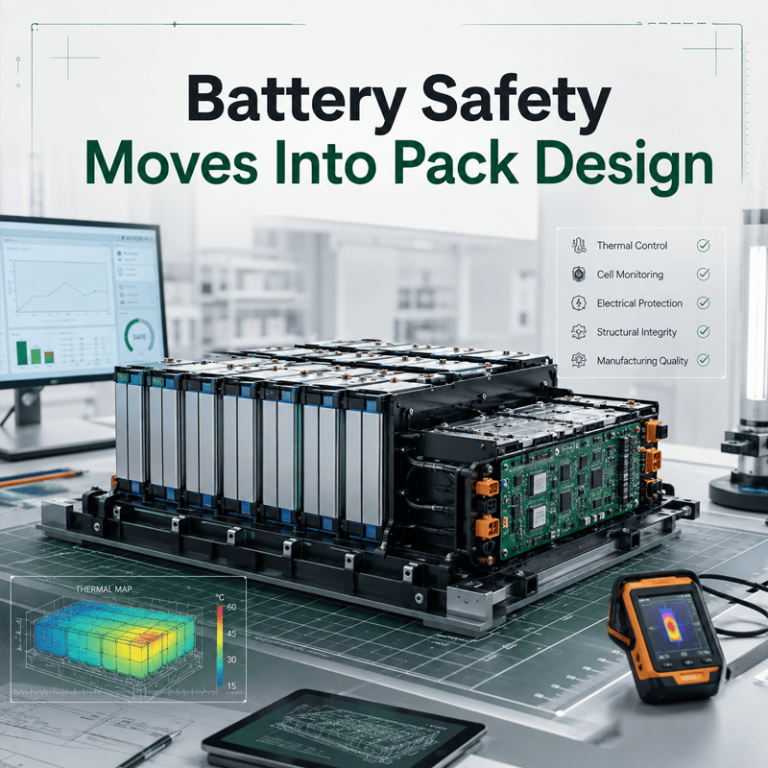 La sicurezza delle batterie si sposta nella progettazione PACK mentre la Cina rafforza il controllo dei rischi legati alle batterie dei veicoli elettrici a catena completa