On October 15, 2026, BMW announced that its sixth-generation (Gen6) high-voltage battery had entered series production in Shenyang for locally produced Neue Klasse models. According to BMW, the program leverages new cylindrical cells, with rigorous safety, quality, and efficiency requirements spanning from initial technology definition and joint development through to engineering validation and commercial series launch. However, this milestone reflects BMW’s proprietary internal capabilities; it does not serve as proof that third-party suppliers can readily replicate its battery architecture, yield rates, or operational performance.
Direct Answer: Why is choosing a cylindrical cell format insufficient to establish battery PACK manufacturability? While a cell format defines the baseline physical geometry, a production-ready module or PACK requires far more: an optimized electrical topology, dependable interconnect methods, comprehensive cell-level sensing, a low-resistance thermal path, robust mechanical retention, dielectric insulation, multi-tiered protection logic, and a deterministic end-of-line (EOL) test plan. These critical interfaces dictate whether a pack design can be consistently assembled at scale and reliably validated for its target operational profile.
The true significance of the Shenyang launch extends beyond the rising industry interest in cylindrical form factors—it demonstrates how high-volume series production transforms an isolated cell choice into a fully controlled, repeatable manufacturing ecosystem. Cylindrical cells can be configured into a wide variety of series-parallel (S/P) arrangements, each introducing distinct trade-offs in operating voltage, current distribution, localized heat generation, and thermal propagation containment. Consequently, the same nominal cell can yield fundamentally different module layouts and PACK-level performance envelopes.
The first buyer checkpoint is the electrical and interconnect architecture. Engineering teams must rigorously establish the target voltage window, continuous and peak current profiles, parallel branch balancing, conductor cross-sections, fusing/protection strategies, and joining methodologies. Busbar routing and micro-welding processes cannot be treated as secondary details: they must withstand cyclic thermal expansion, dynamic mechanical vibration, heavy electrical loads, and standard production tolerances. Furthermore, cell-level voltage and temperature sensing demand unambiguous harness-routing rules and sensor-placement standards before a Battery Management System (BMS) can deliver meaningful, fail-safe protection.
The second checkpoint is structural and thermal harmonization. Cylindrical cells require precise mechanical retention, controlled swelling/safety clearances, and an effective heat-dissipation path tailored to the duty cycle. While high volumetric packing density is desirable, overly compact layouts frequently compromise service accessibility, dielectric isolation, automated optical inspection (AOI), and active cooling efficiency. Buyers must explicitly define ambient environmental extremes, C-rate charging/discharging curves, shock and vibration spectra, mounting orientation, ingress protection (IP) ratings, and maintenance constraints. These inputs directly govern whether air cooling, conductive thermal interfaces, bottom-plate liquid cooling, or specialized module geometries are technically and economically viable.
The third checkpoint is verifiable manufacturing capability. A credible production and quality assurance plan must define incoming quality control (IQC), cell capacity and internal resistance (IR) binning, process capability indices (CpkC_{pk}Cpk), unit-level serialization/traceability, dielectric withstand (Hi-Pot) tests, insulation resistance, and clear acceptance criteria. Crucially, it must also specify which modifications trigger re-validation: an alternate cell vendor, a new cell batch, welding parameter shifts, BMS firmware updates, or enclosure redesigns can all compromise previously completed DV/PV (Design/Production Validation) certifications. Form-factor or capacity similarities never imply automatic plug-and-play equivalency.
For an OEM or system integrator, an actionable Request for Quotation (RFQ) must look well beyond nominal capacity and voltage. A comprehensive RFQ should specify the target duty cycle, usable voltage range, peak and continuous current limits, physical CAD envelope, CAN/communication protocols, thermal boundary conditions, compliance standards (e.g., UN 38.3, UL 2580, ISO 26262), after-sales service models, and validation milestone ownership. Clarifying these boundary conditions upfront dramatically elevates engineering alignment before toolings, fixtures, and prototype designs are frozen.
LYTH View
BMW’s Shenyang milestone is a manufacturing signal, not merely a validation of cylindrical cells. In custom module and PACK development, commercial repeatability is governed not by the bare cell alone, but by the engineered interfaces surrounding it: precision joining, sensing architecture, active thermal management, structural integrity, fault containment, and end-of-line verification.
What LYTH Can Do
LYTH provides comprehensive engineering and manufacturing support—evaluating cell and module options, architecting custom-PACK topologies, harmonizing BMS, thermal, and functional safety requirements, and establishing robust manufacturing and validation protocols for defined applications. Every cylindrical-cell program is executed against confirmed cell performance data, operational boundary conditions, sample feasibility, and application-specific qualification standards.
Sources
 English
 Français
 Deutsch
 Italiano
 Русский
 Español

 CATL–INTILION Cooperation Highlights the Cold-Climate Checks Behind a Battery Subsystem
 EV Battery Module and PACK Interface Checks for Fast-Charging Platforms
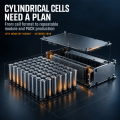 BMW’s Shenyang Gen6 Launch Shows Why Cylindrical Cells Need a Manufacturing Plan
 CATL’s TECTRANS II Launch Shows Why Commercial Battery PACKs Start With the Duty Cycle
 Battery Passport Readiness for Modules and Custom PACKs