
Categories
- Our Blog (82)
- Our Projects (90)
- FAQ (6)
On August 6, 2026, SVOLT reported that its first-half global power-battery installation reached 15.7GWh, with year-on-year growth above the broader market. The company also referenced recent product and process signals including short-blade battery progress, hybrid solid-liquid technology planning, stacking-process improvements, overseas shipment growth, and expansion into new applications. The most useful lesson for module buyers is not that one format …
On August 6, 2026, CnEVPost reported that CALB was carrying out a quality and safety overhaul after widespread battery-cell problems in GAC Aion vehicles. Battery-News summarized the same development on August 7. The reports connected the issue to 177Ah LFP cells used in Aion S vehicles, with complaints including swelling, electrolyte leakage, and sudden power loss after high-mileage operation. The …
Short Description: China’s newly approved GB/T 34013—2026 brings EV traction-battery dimensions back into engineering discussions. For buyers using the VDA355 name, the practical lesson is simple: a familiar module format helps organize a project, but it does not replace a complete compatibility review. Direct Answer: What Is a VDA355 Battery Module? A VDA355 battery module refers to a battery-module format …
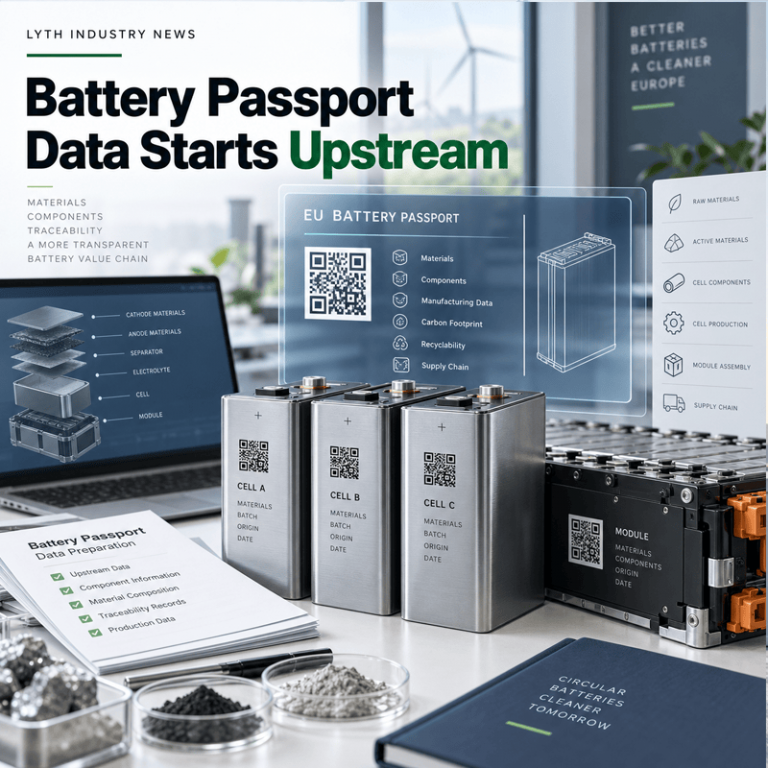
Battery compliance is moving from final certification paperwork into product design, supplier selection, and manufacturing data management. The European Commission’s guidance document, version 1.0 dated July 28, 2026, sets out Digital Battery Passport data points by category for electric vehicle batteries, light means of transport batteries, and industrial batteries. The document does not replace the Battery Regulation itself, but it …
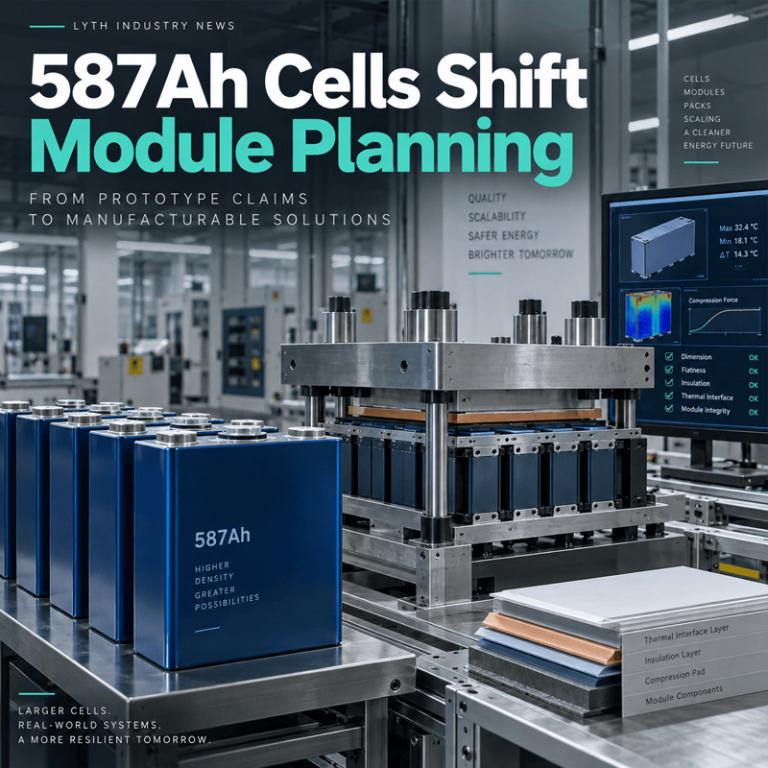
Large-format storage cells have been a major topic in battery discussions for the past year, but recent market communication has shifted the conversation from product positioning to actual delivery status. In an investor-relations record published on July 26, 2026, CATL said its 587Ah large-format storage cell had already achieved scaled delivery. That matters because real delivery is a stronger market …
China’s battery supply chain received a new policy signal in mid-July. In a notice dated July 16, 2026, China’s tax authorities confirmed that lithium-ion batteries will again be subject to consumption tax in stages, with a 2% rate starting on September 1, 2026 and a 4% rate from September 1, 2027. At the same time, sodium-ion batteries and solid-state batteries …
China’s battery supply chain received an important policy signal on July 16, 2026, when the Ministry of Finance, the General Administration of Customs, and the State Taxation Administration issued a new notice adjusting battery consumption-tax policy. Under the notice, lithium-ion batteries return to a 2% consumption-tax rate from September 1, 2026, and then move to 4% from September 1, 2027. …
China’s battery industry is entering a new cost-adjustment phase. Under the official policy released on July 16, 2026, lithium primary batteries and lithium-ion batteries will be subject to a 2% consumption tax from September 1, 2026, with the rate scheduled to rise to 4% from September 1, 2027. At the same time, battery export rebate support has already been reduced …
CATL said on July 12, 2026 that it received the 2026 Volkswagen Group Award and was the only power-battery manufacturer recognized this year. The company also used the announcement to restate several points that matter to battery buyers: it has supplied NCM battery cells for Volkswagen’s MEB platform since 2018, it has delivered more than 200 GWh of cells to …
CATL’s July 6 launch of the Tectrans II light-commercial battery is more than a product update. It is a practical signal that fast-charging expectations in logistics and delivery vehicles are moving closer to passenger-EV territory, with direct implications for module design, cooling strategy, and PACK integration. Formal English Body Copy On July 6, 2026, CATL introduced the Tectrans II battery …
China’s updated EV battery safety rule took effect on July 1, 2026. For battery-module and PACK suppliers, the change is not just regulatory news, but a practical design signal around thermal propagation control, structural protection, and validation workflow. Formal English body copy China’s mandatory standard GB 38031-2025, officially titled Safety requirements for power batteries used in electric vehicles, entered into …
On July 1, 2026, China’s updated mandatory EV battery safety standard, GB 38031-2025, formally entered into effect. Official and attributable reporting around the implementation has focused on stronger safety expectations at the battery system level, including tighter attention to thermal event control and more demanding validation logic. For the battery industry, this is important because compliance pressure does not stop …