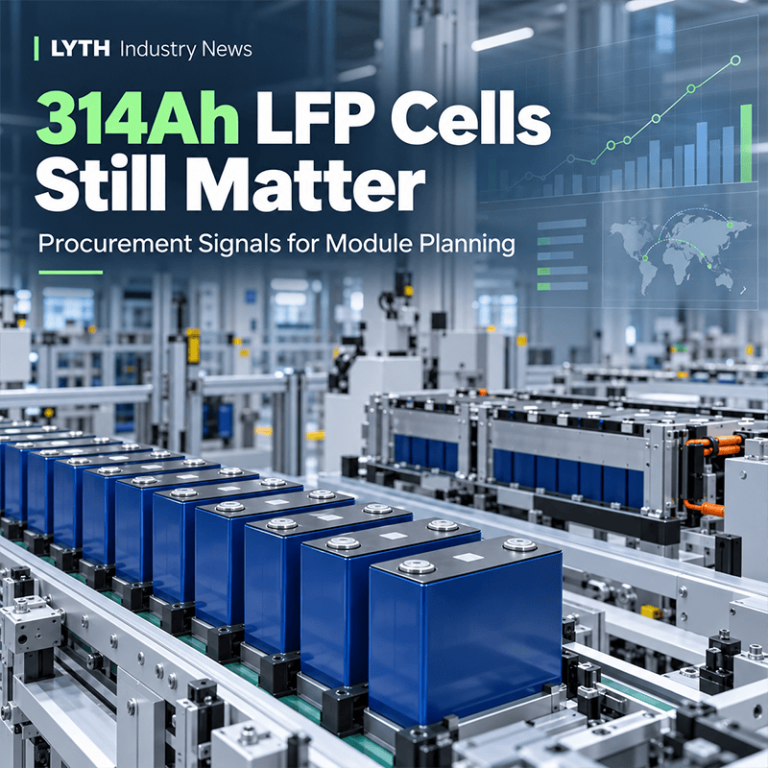
China’s battery market continues to move quickly toward higher-capacity storage cells, but a recent procurement signal shows that 314Ah LFP cells remain an important practical reference. Chinese battery media reported that China Energy Engineering’s 2026 LFP battery procurement included a 1GWh package for 314Ah LFP cells, with Pengcheng Wuxian listed among the successful suppliers. The same reporting cited requirements around delivery record and cell capacity, pointing to the importance of proven supply rather than only headline capacity.
For buyers, this matters because battery design decisions are rarely made on nominal amp-hour rating alone. A 314Ah LFP cell may be attractive when it has a clearer supply base, familiar mechanical dimensions, known thermal behavior, and more mature production experience. Newer large-capacity cells can reduce part count in some systems, but they may also require new fixtures, compression strategy, BMS parameter validation, busbar redesign, and shipping-document updates.
The practical question is: can the selected cell fit the module or PACK architecture without creating hidden engineering risk? A module design built around one cell format may need adjustment when changing cell thickness, terminal layout, swelling allowance, current path, or thermal interface. Even when chemistry remains LFP, the electrical and mechanical details can affect cycle-life behavior, enclosure design, assembly pressure, and serviceability.
For small commercial storage, telecom backup, industrial equipment, and custom PACK projects, stable manufacturability can matter as much as the newest capacity class. Buyers should ask whether the supplier can provide the target cell model, batch traceability, matching data, mechanical drawings, BMS configuration support, and sample validation before committing to a module or PACK design.
LYTH View:
The recent procurement signal suggests that 314Ah LFP is still not obsolete. It remains a useful planning baseline for buyers who need a balance between availability, integration maturity, and predictable module engineering. LYTH should treat larger-capacity cells as a watch area, while continuing to support practical designs around available and validated cell formats.
What LYTH Can Do:
LYTH can support cell sourcing checks, battery module development, custom PACK integration, BMS adaptation, and sample-based engineering review for projects using mainstream LFP cells. For 314Ah-related projects, LYTH should confirm current model availability, dimensions, batch data, and application requirements before proposing a module or PACK structure.
Sources: 电池网, 国际储能网, 世纪新能源网


 314Ah LFP Cells Still Matter for Battery Module Planning
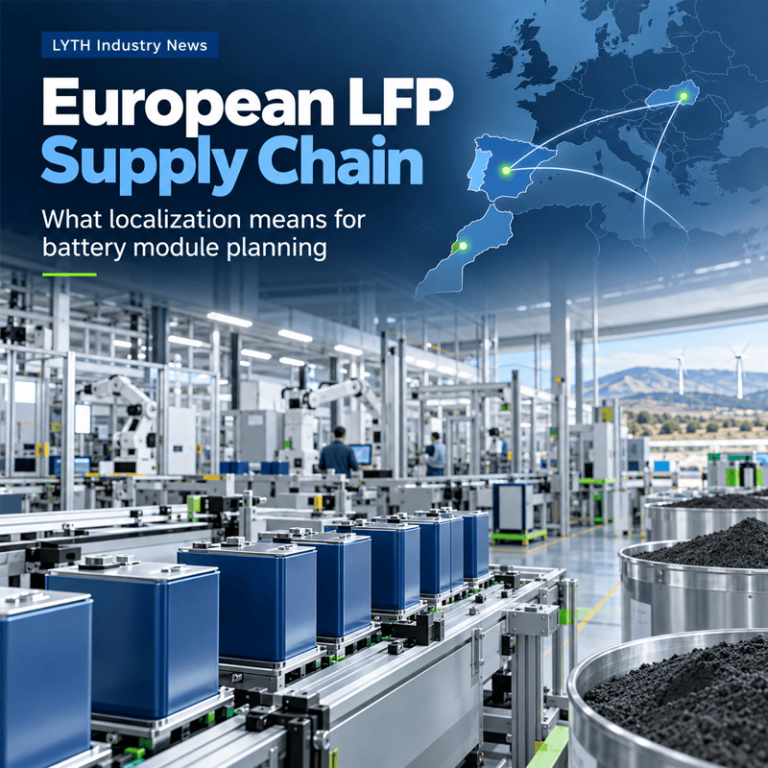 European LFP Battery Localization and Module Planning
 AI Battery Packs for Commercial EVs: What Cell-Level Sensing Changes for Integration
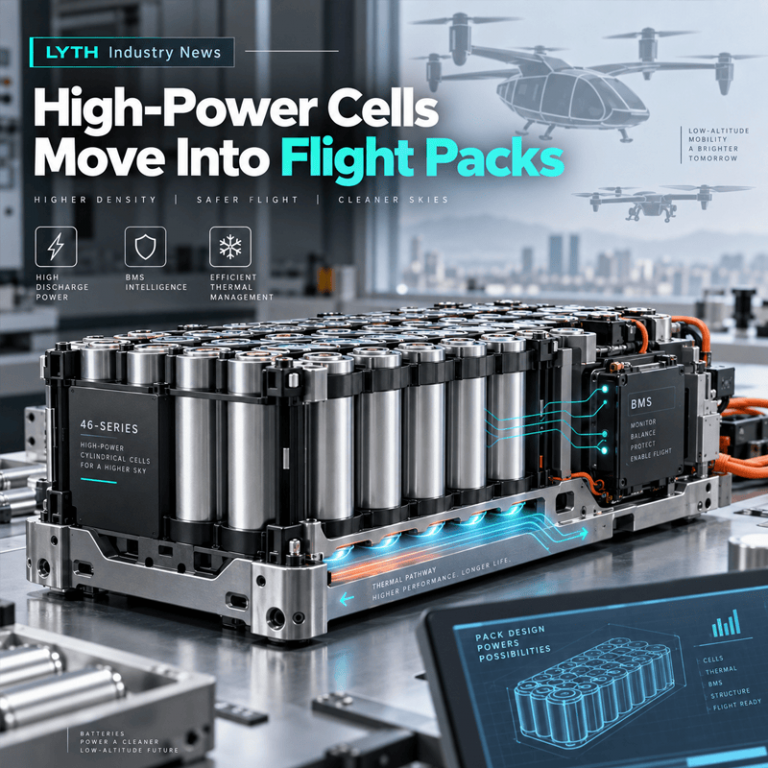 High-Power Cells Move Into Flight Packs: What Low-Altitude Batteries Require Beyond Capacity
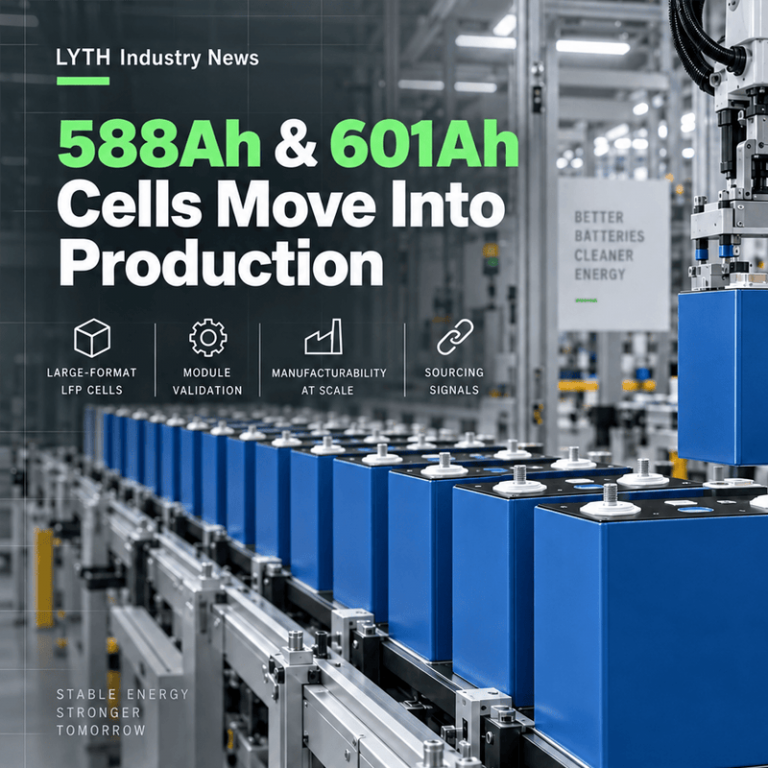 588Ah and 601Ah LFP Cells Move From Product Roadmap to Manufacturing Signal