1. Industry Context: The Shift to 2-in-1 Master Controllers
On October 9, 2026, China Energy Storage Network highlighted Gaote Electronics’ commercial launch of its third-generation “two-in-one” master-control high-voltage box designed for dual-cluster energy storage systems.
The industry trend is clear: moving away from two completely redundant BCM units toward an integrated controller capable of managing two battery clusters simultaneously, while maintaining physical and electrical isolation between Cluster A and Cluster B.
The technical claims behind Gaote’s F233 controller illustrate this shift:
- Independent A/B Cluster Detection: Doubled voltage and temperature sampling channels.
- Expanded I/O Capability: 17 Digital Outputs (DO) and 11 Digital Inputs (DI).
- Robust Telemetry: Redundant dual-network interfaces, multiple RS-485 cascade buses, and IP67 panel protection.
- Platform Breadth: DC 1500V compatibility across standard 280Ah/314Ah cells up to ultra-large 587Ah/588Ah/628Ah platforms.
However, these specifications should not be treated as a plug-and-play solution for every custom project. Instead, they signal a critical industry reality: system integration is rapidly becoming a BMS architectural challenge, not merely a bill-of-materials (BOM) cost reduction.
2. The Buyer’s Dilemma: Hardware Savings vs. Architecture Integrity
When a battery subsystem parallels two clusters into one enclosure, a practical question arises for procurement and engineering teams:
Is the supplier genuinely engineering for dual-cluster reliability, or are they simply cutting enclosure costs at the expense of protection redundancy?
A high-voltage control box is far more than a sheet-metal housing for contactors and fuses. In an energy storage system (ESS), it acts as the primary sensory and actuation hub. It directly coordinates:
- Voltage & temperature measurement
- Contactors and pre-charge sequencing
- Communication topologies (PCS / EMS / Master BMS)
- Insulation resistance monitoring
- Thermal management actuation (chillers, heaters, valves)
- Safe fault containment
When two clusters operate in parallel, the design must guarantee that a fault, wiring damage, or telemetry error in Cluster A cannot cascade into or destabilize Cluster B.
3. Engineering Checklist: 5 Verification Points for Custom PACK Buyers
For engineers and buyers evaluating custom battery modules or light commercial energy storage, keep this checklist on your technical audit agenda:
| Evaluation Area | Red Flag (Pure Cost-Cutting) | Engineering Best Practice |
|---|
| Voltage & Temp Sampling | Multiplexed/shared ADC channels; cross-talk risk | Dedicated, galvanically isolated acquisition channels for A and B |
| Thermal Actuation (DO) | Single DO output triggering shared chilling/heating | Zoned DO relays managing independent thermal loops per cluster |
| Fault Isolation | Shared contactors or unsegregated fuse paths | Independent contactors & disconnects; isolated trip logic |
| Harness & Assembly | Cluttered internal high/low voltage cable runs | Pre-formed wiring harnesses, anti-vibration routing, IP-rated seals |
| Batch Consistency | Hand-assembled prototypes with varying tolerances | Standardized jigs, laser-welded busbars, and EOL automated testing |
4. The “Large-Cell” Trap: Cell Specs Do Not Define Subsystem Safety
The dual-cluster trend is closely intertwined with the rapid rise of 314Ah, 587Ah, and 628Ah prismatic cells. However, cell datasheets alone never define final system reliability.
The same cell model behaves drastically differently across varying operational envelopes. Mechanical compression frames, busbar thermal dissipation, sampling harness routing, dielectric barriers, and BMS threshold parameters must all adapt to:
- System voltage platforms (DC 750V vs. DC 1500V)
- Daily cycle profiles (0.5C continuous vs. 1C peak)
- Site environmental limits (ambient -30°C to +55°C)
- Field maintenance and module replacement access
A serious discussion around custom PACKs must address mechanical manufacturability and electrical topology, not just nominal voltage and cell branding.
5. The LYTH Perspective: Pragmatic Subsystem Engineering
At LYTH, our focus remains precisely where real-world hardware meets field reliability: prismatic cell sourcing, custom battery modules, engineered PACK integration, and BMS thermal/electrical adaptation.
We do not position ourselves as utility-scale EPC station integrators. Instead, our value lies in helping commercial integrators, telecom operators, and specialty OEMs engineer safe, repeatable battery subsystems from the ground up:
- 100% Brand-New Grade-A Cells: Authentic factory QR codes and full capacity/IR matching before assembly.
- Architecture-First Customization: DFM reviews for busbar current density, cell compression retention, and dual-cluster BMS compatibility.
- Thermal & Safety Coordination: Integration of aerogel insulation barriers, heating films, and isolated sensing layouts.
- Verifiable Compliance Support: Assistance with UN38.3 test summaries, MSDS, and third-party laboratory coordination.
Discuss Your Battery Architecture
Are you designing a dual-cluster light commercial cabinet, an off-grid industrial pack, or integrating high-capacity 314Ah/Na+ cells?
Talk directly with our engineering team. Share your target voltage, capacity, and physical envelope for a preliminary mechanical and BMS feasibility review.
- 🌐 Website: www.lythbattery.com
- ✉️ Engineering Inquiries:
info@lythbattery.com / Contact our technical team via the website portal.


 Dual-Cluster Storage Integration: Hardware Cost-Cutting or Real Electrical Architecture?
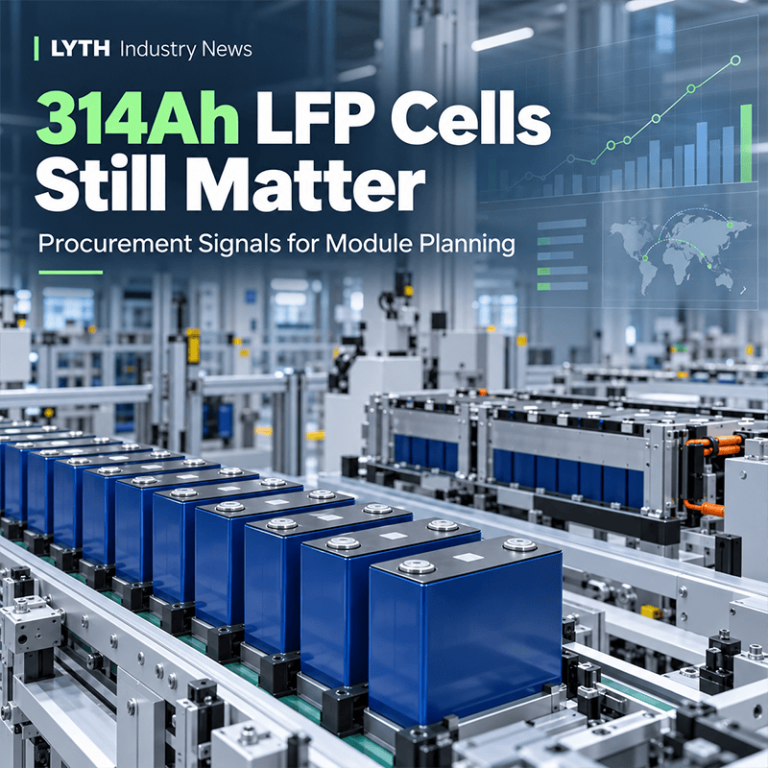 314Ah LFP Cells Still Matter for Battery Module Planning
 European LFP Battery Localization and Module Planning
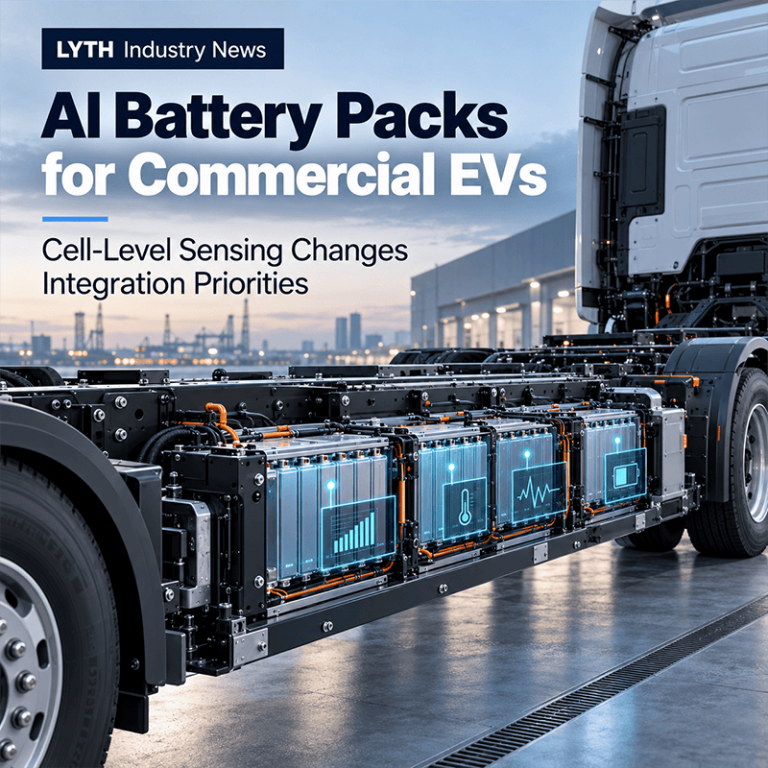 AI Battery Packs for Commercial EVs: What Cell-Level Sensing Changes for Integration
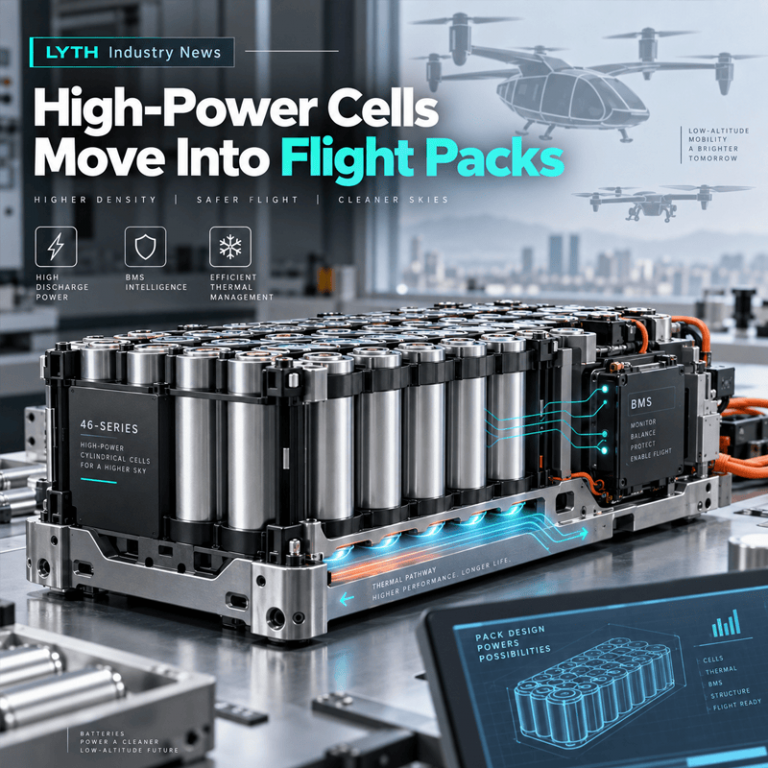 High-Power Cells Move Into Flight Packs: What Low-Altitude Batteries Require Beyond Capacity