Sur 2026-08-31, ChinaEV100 a publié le résumé d'un séminaire de haut niveau sur les risques de sécurité et les mécanismes de protection des batteries des véhicules à énergies nouvelles.. Le séminaire a réuni des groupes industriels, instituts de recherche, constructeurs automobiles, entreprises de batteries, prestataires de services, et les acteurs du secteur des assurances. Le message principal était clair: à mesure que l’adoption des véhicules électriques se développe, les risques pour la sécurité des batteries deviennent de plus en plus multi-scénarios, scène croisée, et dynamique.
La discussion s’est déroulée dans le contexte des nouvelles exigences chinoises en matière de sécurité des véhicules et des batteries de traction., y compris GB18384-2025 et GB38031-2025. D'après le résumé ChinaEV100, la nouvelle étape de gouvernance de la sécurité des batteries met davantage l’accent sur la diffusion thermique, protection du fond, systèmes à haute tension, qualité de fabrication, partage de données, service après-vente, et traçabilité tout au long du cycle de vie.
Réponse directe
Pour les acheteurs de modules de batterie et de PACK personnalisés, l'implication pratique est que la sécurité ne peut plus être évaluée uniquement au niveau du produit fini. Un projet devrait évaluer la sélection des cellules, conception structurelle, Logique GTC, coordination thermique, isolation, scellage, cohérence de fabrication, traçabilité des lots, et les conditions de fonctionnement spécifiques à l'application avant de confirmer la conception d'un module ou d'un PACK.
Ce changement est important car les risques liés à la batterie n’apparaissent pas à un seul endroit. Une cellule techniquement adaptée peut néanmoins devenir inadaptée si la structure du pack crée une compression inégale., mauvaise dissipation de la chaleur, faible isolation électrique, ou accès difficile au service. Un BMS peut lire correctement la tension et la température des cellules, mais nécessitent toujours une logique spécifique au projet pour les limites de charge, comportement à basse température, protection contre les surintensités, protocole de communication, et réponse aux pannes. Un module peut réussir les contrôles de base dans une application mais être confronté à une exposition à des risques différente dans les véhicules logistiques, équipement de mobilité, sauvegarde des télécommunications, ou petit stockage commercial.
La discussion sur ChinaEV100 a également mis l'accent sur la cohérence de la fabrication. Ce point est directement pertinent pour la production PACK. Même lorsque les cellules, jeux de barres, matériaux d'isolation, et les boîtiers sont spécifiés correctement, la variation du processus peut affecter la fiabilité à long terme. Qualité du soudage, contrôle du couple, regroupement de cellules, mise en place de l'isolation, scellage, précision du montage, et les enregistrements de tests finaux font partie du système de sécurité. Les acheteurs doivent donc se demander comment un fournisseur contrôle le processus de production, non seulement quelles pièces sont répertoriées dans le devis.
Pour remplacement, rénovation, ou des projets personnalisés en petits lots, l'examen de sécurité devrait être encore plus prudent. De nombreux acheteurs se demandent d'abord si la tension, capacité, et les dimensions correspondent à l'application cible. Ces contrôles sont nécessaires, mais ils ne suffisent pas. Les ingénieurs doivent également confirmer l'orientation de montage, exposition aux vibrations, espace clos, méthode de refroidissement, courant de pointe, interface de communication, comportement du chargeur, et le cycle de service attendu. Un PACK conçu pour un usage de secours occasionnel n'est pas automatiquement adapté à la mobilité haute fréquence ou aux équipements industriels.
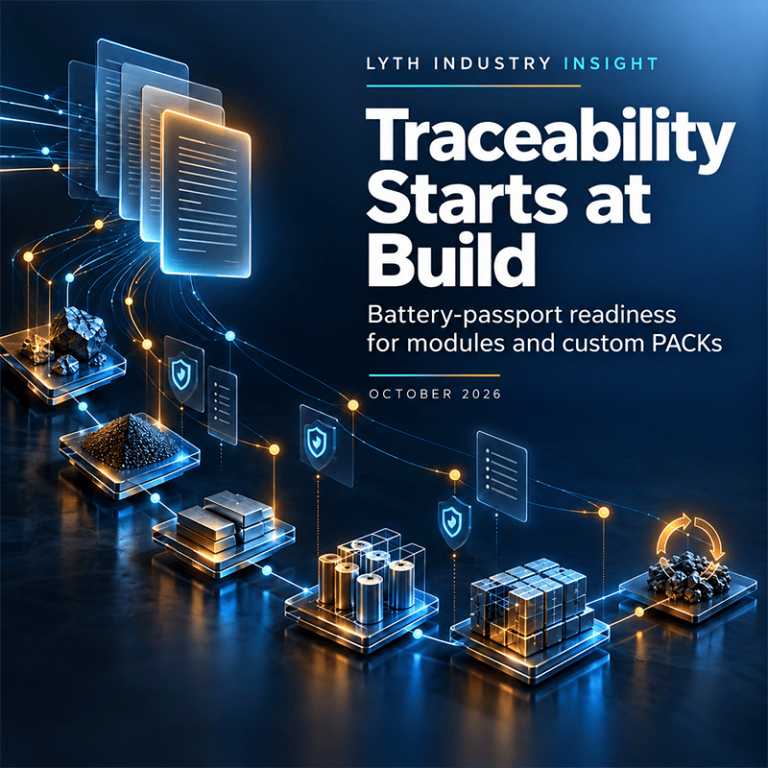
Cette évolution renforce également la valeur de la traçabilité. La gestion de la sécurité des batteries dépend de plus en plus de la connaissance des cellules utilisées, comment ils ont été regroupés, quels tests ont été effectués, et comment la batterie se comporte en fonctionnement réel. Pour les acheteurs internationaux, la traçabilité est également liée à l'évaluation de la garantie, documents d'expédition, dépannage technique, et les décisions de service futures.
Pour LYTH, la réponse la plus crédible est de ne pas revendiquer une large autorité de sécurité au niveau du système. La couche pertinente est le support technique des modules et des PACKS: aider les acheteurs à confirmer les exigences de la demande, adéquation du modèle cellulaire, structure des modules, Correspondance BMS, protection thermique et électrique, faisabilité de fabrication, et documents de livraison.
Voir LYTH
La sécurité des batteries ne dépend plus d'un simple certificat réussite/échec mais plutôt d'une discipline d'ingénierie tout au long du cycle de vie du module et du PACK.. LYTH devrait traiter la sécurité comme un processus de mise en correspondance des applications: le bon modèle de cellule, structure, Stratégie GTB, et les contrôles de production doivent être adaptés au cas d'utilisation réel.
Ce que LYTH peut faire
LYTH peut aider les acheteurs dans la sélection du module de batterie, révision de la structure du PACK personnalisé, Adaptation GTB, coordination thermique et sécurité, et contrôles de faisabilité de fabrication pour des applications telles que les modules EV, batteries de secours pour télécommunications, équipement de mobilité, et sous-systèmes de stockage commerciaux légers.
Sources
Résumé du séminaire sur la sécurité des batteries ChinaEV100
2026 Rapport de la Conférence mondiale sur les batteries de puissance


 Préparation au passeport de batterie pour les modules et les packs personnalisés
 Navires LYTH 16,000 Cellules de batterie CALB 314Ah vers l’Europe
 587Moyens de production de masse de cellules Ah pour les acheteurs de modules de batterie et de PACK
 Intégration du stockage à double cluster: Réduction des coûts matériels ou véritable architecture électrique?
 314Les cellules Ah LFP sont toujours importantes pour la planification des modules de batterie