China’s August 2026 battery data gives buyers a clear signal: storage batteries are becoming a larger and more dynamic part of the battery supply chain. According to industry data released on September 15, China’s power and energy-storage battery sales reached 223.1GWh in August 2026, with storage battery sales showing particularly strong year-on-year growth.
For buyers of battery modules and custom PACKs, this matters because storage growth affects more than large grid projects. It can influence cell availability, batch planning, qualification timing, export documentation, and the selection of compatible BMS and thermal-control designs.
A storage battery order usually begins with a cell decision, but it does not end there. Even when a suitable LFP cell is available, buyers still need to confirm the model, capacity grade, dimensions, terminal design, cycle-life assumptions, communication requirements, shipment conditions, and certification path. If storage demand rises quickly, these details become more important because alternative cell models may need to be evaluated earlier.
This is especially relevant for residential storage, telecom backup, small commercial storage, and light industrial battery systems. These applications often need stable module formats, predictable voltage platforms, and clear service requirements. A cell that works well in one system may still require new fixtures, busbar design, BMS parameter matching, thermal review, and charge-discharge validation before it can be used in another PACK.
For international buyers, export momentum adds another layer. Battery sourcing is increasingly tied to documentation: product specification sheets, test reports, shipping classification, production traceability, and supplier consistency. A low unit price is not enough if the buyer cannot confirm whether the selected cell batch can support the target PACK design and destination-market requirements.
The practical lesson is simple: storage demand growth makes early technical confirmation more valuable. Buyers should not wait until final procurement to ask whether a cell can fit a PACK design. They should define the application, electrical requirements, installation environment, communication interface, expected cycle profile, and certification needs before locking the cell model.
LYTH View:
The August data suggests that storage battery growth is becoming a sourcing-quality issue, not only a market-size story. For LYTH, the strongest opportunity is to help buyers connect cell sourcing with module and PACK feasibility, especially where LFP cells must be adapted for telecom backup, residential storage, and small commercial battery systems.
What LYTH Can Do:
LYTH can support cell model confirmation, battery module development, custom PACK integration, and application matching for buyers who need sourcing and engineering coordination. For storage-related projects, LYTH can help evaluate cell alternatives, module structure, BMS adaptation, thermal layout, and production feasibility before batch procurement.
Sources:
China Automotive Battery Innovation Alliance monthly data via NE Times
Mysteel summary of August 2026 power and storage battery data
MIIT-linked H1 2026 lithium battery industry data via Economic Observer


 Dual-Cluster Storage Integration: Hardware Cost-Cutting or Real Electrical Architecture?
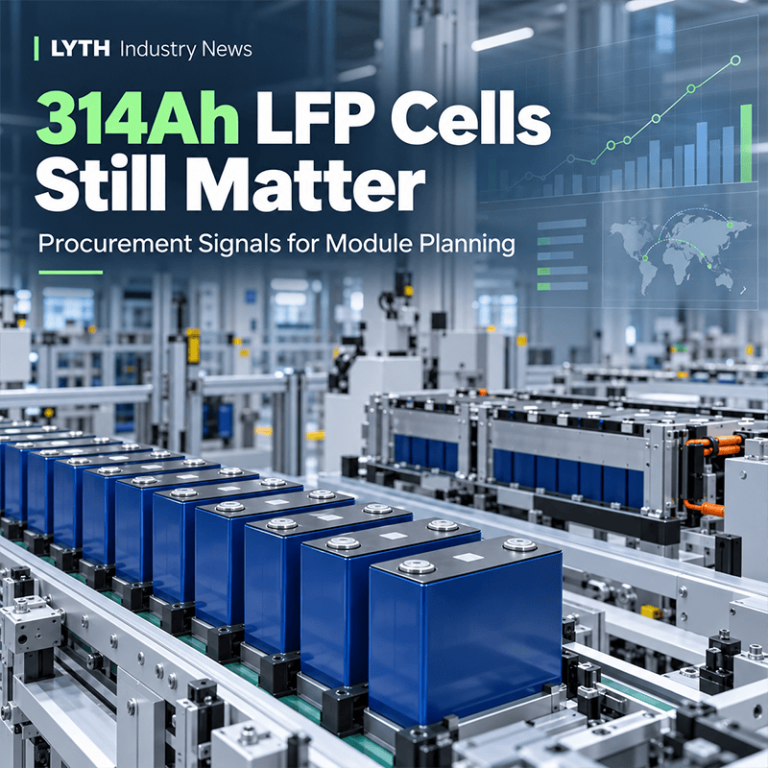 314Ah LFP Cells Still Matter for Battery Module Planning
 European LFP Battery Localization and Module Planning
 AI Battery Packs for Commercial EVs: What Cell-Level Sensing Changes for Integration
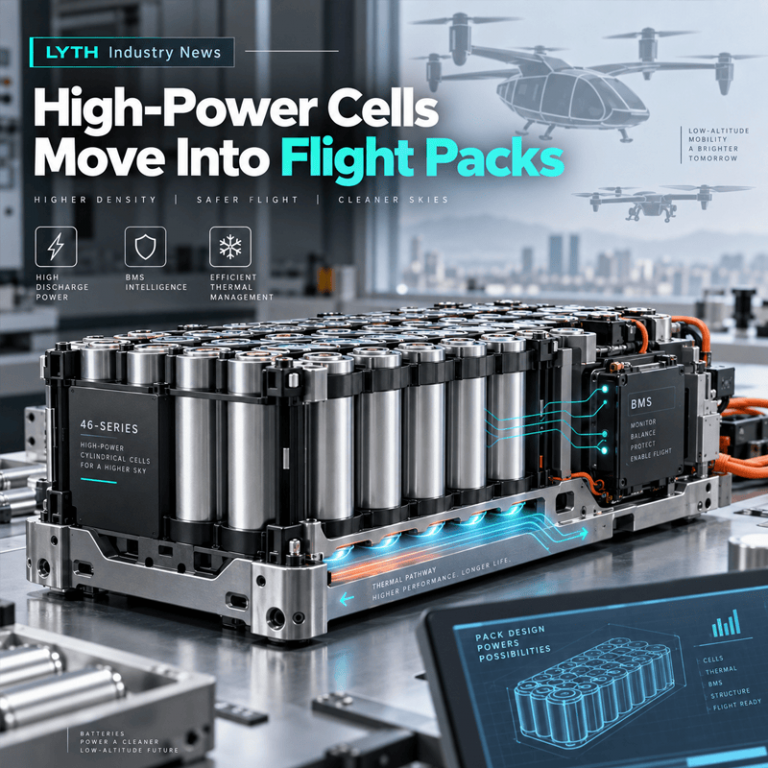 High-Power Cells Move Into Flight Packs: What Low-Altitude Batteries Require Beyond Capacity