On August 6, 2026, CnEVPost reported that CALB was carrying out a quality and safety overhaul after widespread battery-cell problems in GAC Aion vehicles. Battery-News summarized the same development on August 7. The reports connected the issue to 177Ah LFP cells used in Aion S vehicles, with complaints including swelling, electrolyte leakage, and sudden power loss after high-mileage operation.
The commercially important point is not only that one supplier faced a quality controversy. It is that battery buyers are being reminded how much final PACK reliability depends on cell-level manufacturing discipline. Electrode coating tolerance, moisture control during electrolyte filling, retained-sample traceability, welding margins, casing design, and BMS data review all affect what happens after a module or PACK has spent years in real service.
For custom battery PACK projects, the lesson is practical: a cell model name and capacity rating are not enough. Buyers should ask how cells are screened before assembly, how batches are identified, how voltage and internal-resistance consistency are checked, and how abnormal data can be traced back to production lots. These checks are especially important when a PACK is designed for taxis, light commercial vehicles, telecom backup, mobile storage, or other applications with high cycling, vibration, heat exposure, or continuous standby duty.
The reported CALB response also highlights the role of organizational control. According to CnEVPost, CALB’s quality department was given stronger authority over batch release, while customer quality teams were set up to review BMS data with vehicle manufacturers. For module and PACK manufacturers, this reinforces a simple principle: production speed should not override quality release criteria when safety, warranty exposure, and customer downtime are at stake.
LYTH View:
For LYTH, this development supports a more engineering-led conversation with buyers. The right question is not “which cell is cheapest?” but “which cell batch, module structure, BMS logic, thermal plan, and inspection process fit the application?” A stable PACK program should define quality gates before mass assembly, not after field complaints appear.
What LYTH Can Do:
LYTH can support battery cell sourcing checks, battery module development, custom PACK integration, BMS adaptation, and application matching for projects where reliability and traceability matter. For high-duty applications, LYTH can help buyers clarify cell model requirements, module configuration, protection logic, and manufacturing inspection points before production.
Sources: CnEVPost, August 6, 2026; Battery-News, August 7, 2026


 Dual-Cluster Storage Integration: Hardware Cost-Cutting or Real Electrical Architecture?
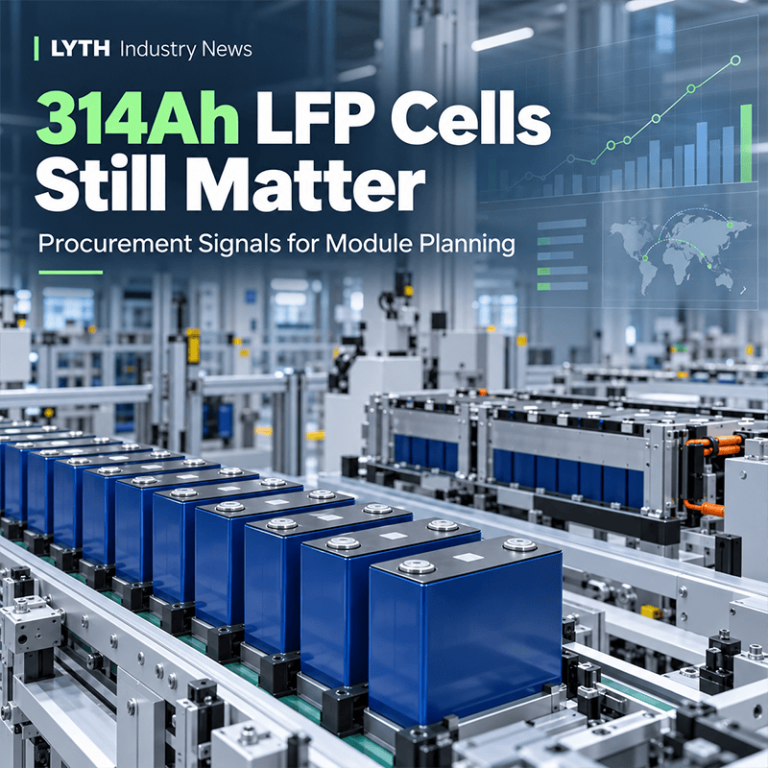 314Ah LFP Cells Still Matter for Battery Module Planning
 European LFP Battery Localization and Module Planning
 AI Battery Packs for Commercial EVs: What Cell-Level Sensing Changes for Integration
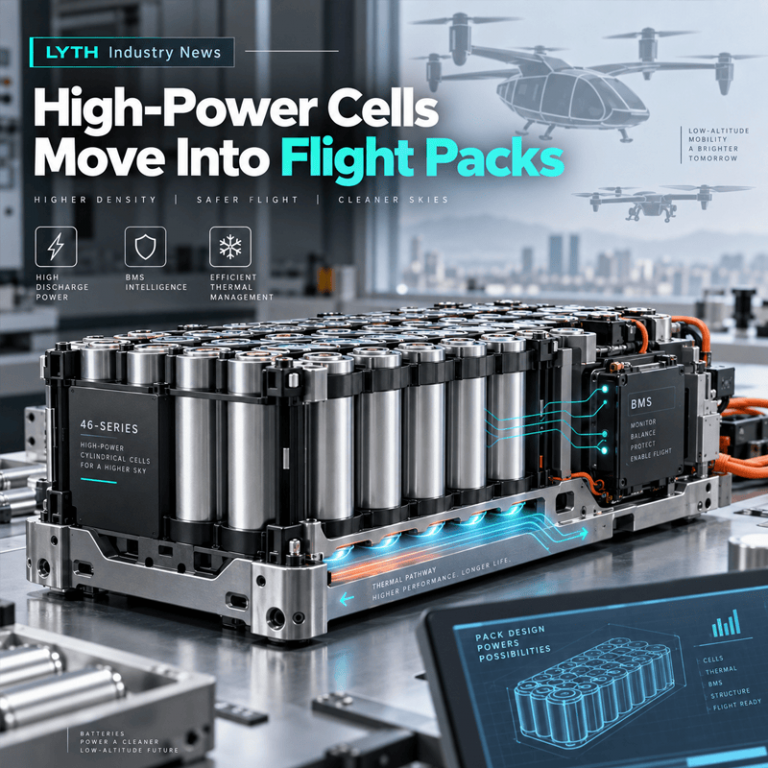 High-Power Cells Move Into Flight Packs: What Low-Altitude Batteries Require Beyond Capacity