En août 6, 2026, OFweek a rapporté que BAK Battery a lancé une cellule LFP prismatique de 85 Ah pour les applications de stockage d'énergie AIDC.. Le rapport décrivait la cellule comme conçue pour une décharge à haut débit, faible résistance interne, réponse rapide au pouls, et couverture de certification de sécurité, y compris UL9540A et UL1973. Il a également déclaré que le produit était entré en production de masse..
Réponse directe: an AIDC-oriented high-rate cell changes PACK design because the battery must support sudden power demand, not only long backup duration. Cell impedance, heat generation, BMS sampling speed, résistance de contact, logique de protection, and enclosure airflow or cooling all become part of the application match.
This matters because AI data centers and high-density computing loads can create faster and sharper power fluctuations than traditional standby applications. A backup battery used in this context may need to deliver strong pulse power, keep voltage stable, and avoid excessive heat rise during repeated high-current events. If the PACK is designed only around nominal voltage and capacity, the result may look acceptable on paper but fail the real operating profile.
For custom PACK engineering, the first design layer is the cell itself. A high-rate LFP cell can support stronger discharge performance, but the final battery pack depends on how that cell is connected, refroidi, surveillé, and protected. Busbar sizing, weld quality, résistance de contact, fuse strategy, current-sensor range, temperature-sensor placement, and BMS firmware settings can all affect whether the PACK can safely use the cell’s rated performance.
The second layer is thermal coordination. High current creates heat through internal resistance and connection resistance. Even when the cell supplier reports controlled temperature rise under defined test conditions, a real PACK must account for enclosure volume, ventilation, installation orientation, surrounding equipment, ambient temperature, and duty cycle. For telecom cabinets, UPS rooms, and small commercial backup systems, these practical conditions can be more important than the headline discharge rate.
The third layer is communication and protection. AIDC, télécom, and backup power systems often require clear status reporting, fault isolation, and predictable cut-off behavior. The BMS must translate cell-level capability into system-level reliability by setting current limits, temperature thresholds, SOC windows, stratégie d'équilibrage, alarms, and communication protocols that match the host equipment.
Pour les acheteurs, la leçon pratique est simple: do not specify a high-rate backup PACK only by capacity. Ask for the intended discharge profile, peak current duration, méthode de refroidissement, BMS protocol, certification boundary, installation temperature range, and validation test plan. The cell model is the starting point; the PACK design decides whether the cell can be used responsibly.
Voir LYTH
The AIDC battery trend is useful for LYTH because it connects directly to custom PACK engineering rather than utility-scale station delivery. LYTH should treat high-rate cells as an engineering evaluation topic: the opportunity is real, but every project still needs cell data, Adaptation GTB, examen thermique, and application-specific validation before commercial positioning.
Ce que LYTH peut faire
LYTH can support buyers with cell model comparison, module or PACK structure evaluation, Adaptation GTB, and thermal/safety coordination for telecom backup, UPS, équipement industriel, and light commercial storage applications. For high-rate projects, LYTH should confirm duty cycle, exigences en matière de communication, enclosure constraints, and target certifications before final quotation.
Sources
OFweek: AIDC进入毫秒级功率响应时代,比克85Ah高倍率电芯应需而生
UL Solutions: Energy Storage System Testing and Certification


 Intégration du stockage à double cluster: Réduction des coûts matériels ou véritable architecture électrique?
 314Les cellules Ah LFP sont toujours importantes pour la planification des modules de batterie
 Localisation européenne des batteries LFP et planification des modules
 Packs de batteries AI pour véhicules électriques commerciaux: Quels changements la détection au niveau cellulaire pour l’intégration
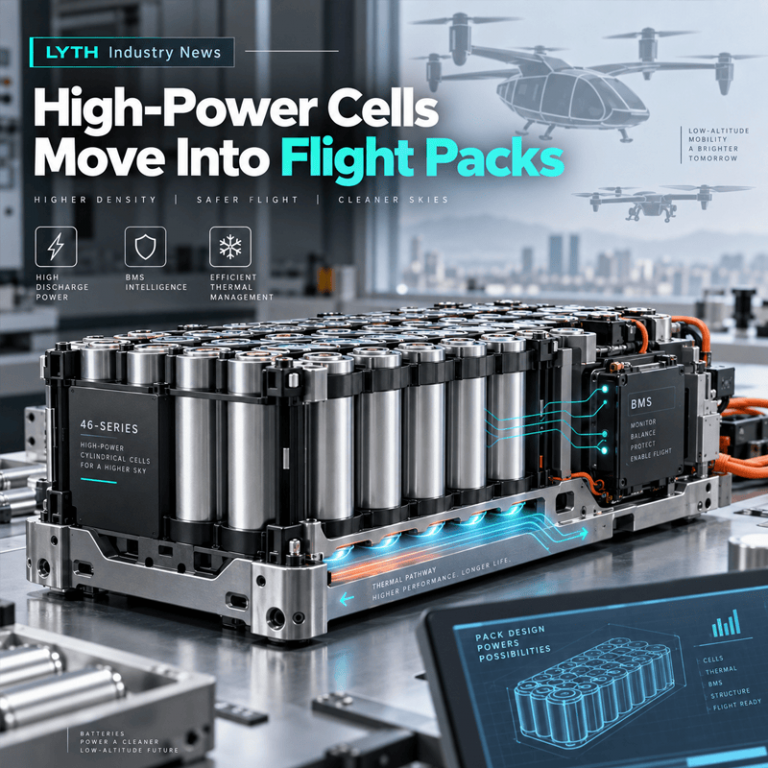 Les cellules haute puissance sont intégrées aux packs de vol: Ce dont les batteries à basse altitude ont besoin au-delà de leur capacité